 |
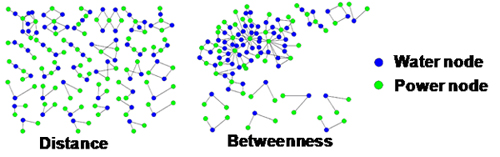
The Effects of Interdependence on Houston Utility SystemsPrincipal Investigator: Leonardo Dueñas-Osorio, Rice University Project Goal: To introduce a performance assessment methodology for coupled utility systems that links physical fragility modeling to wind hazards with the layout or topology of their connecting interfaces. Distinct interfaces based on features such as how in between a particular electrical substation is to all other electrical substations (betweenness), how many feeders a substation has (degree), or how close substations are to other utility system stations (distance) are assessed regarding their role in connecting utility systems and propagating failures from hurricane events. Report completion anticipated for August – 2011. Background: The reliability assessment of infrastructure systems providing power, natural gas, and potable water is an integral part of societal preparedness to unforeseen hazards. The layout or topological properties of interface networks connecting electric substations to water pumping stations and natural gas compressors have received little attention despite the key role these connections play in operation and failure propagation. Status Report (June 2010): The interface minimizing the distance between electric substations and other utility nodes has been found to exhibit a slow performance decline as random failures increase. This interface also retains the greatest functionality under hurricane events compared to alternative interfaces, although it suffers from limited efficiency and controllability during normal operation. A convenient hybrid interface using both betweenness and distance features shows adequate performance during normal operation while exhibiting tolerance to random failures and sufficient performance at increasing hurricane event levels. These findings provide utility owners and operators with new simple yet adequate strategies focused at the interface across complex systems, as opposed to entire system of systems, to enhance routine operation and reduce the probability of widespread interdependent infrastructure failures following disruptive events. Figures 1 and 2 with three critical utility systems in Harris County and their enhanced interfaces are presented below.
|