 |
The Ike Dike: A Proposal to Mitigate Severe Storm Destruction on the Texas Gulf CoastStatus report by SSPEED Center staff, May 2010 Over the last decade the Houston-Galveston region has experienced several hurricanes and a tropical storm that have had a devastating impact on the Gulf Coast community. In 2008, a particularly powerful Hurricane Ike hit the Texas Gulf Coast causing approximately $30 billion in damage and killing nearly 200 people. The frequency and severity of destruction has underscored the vulnerability of our coast against severe storms. As such, the need for an updated and more innovative response to counter future disasters is urgently needed. This need has been codified by the State of Texas with the Governor’s Commission for Disaster Recovery and Renewal (Governor’s Commission) recommending that a study be funded to determine the practicability of implementing a levee system to protect the Texas Gulf Coast from future storm surges. In the meantime, a group of researchers at the Institute of Computational Engineering and Sciences (ICES) at The University of Texas at Austin is running various sophisticated computer simulations to see what would happen under a variety of conditions. Their research results will inform decisions on whether to proceed with a wall. Such a levee system is not a new idea. The last severe hurricane to strike the Texas Gulf Coast was the Great Storm of 1900. Making landfall at Galveston, Texas, the Great Storm killed an estimated 6,000 residents and produced a storm surge that obliterated the City. Realizing that it could happen again, the region’s leaders commissioned the construction of the Galveston Seawall, which today stands 15.6 feet high and stretches 10 miles along the east coast of Galveston Island. More than a century later, Hurricane Ike produced a storm surge of even greater destruction, inundating most of the Island. And like the Great Storm, Hurricane Ike has revived the idea of building a wall to keep out the water.
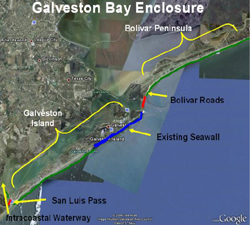
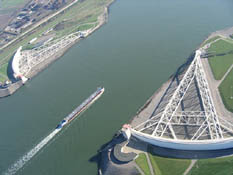
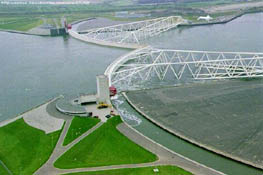
A new levee system termed the “Ike Dike” is the idea of Dr. Bill Merrill, a George P. Mitchell professor of Marine Sciences at Texas A&M at Galveston, Director of the Center for Texas Beaches and Shores, and Chairman and Principle Scientist of The Institute for Oceans and Coasts. Dr. Merrill has envisioned the Ike Dike to extend the 60 miles from High Island to south of the San Luis pass at a height of 17 feet, protecting Galveston Bay and the surrounding area. In addition to the fixed structure of the Ike Dike, the proposal calls for the implementation of a flood gate to close off a nearly two mile stretch of open water between Galveston Island and Bolivar Peninsula. The design, modeled from the Maeslantkering storm surge barrier across the Rotterdam channel in the Netherlands (see pictures below), is intended to allow water to circulate through Galveston Bay while maintaining the ability to close off the Bay to storm surge given a severe storm event.
Dr. Merrill has estimated the Galveston portion of the Ike Dike to cost roughly $3 billion, or only 5-6 cents of property tax for residents in the affected counties over the next 30 years. Wayne Klotz, president of the Houston engineering firm Klotz Associates Inc., believes the estimate is higher at around $7 billion to $10 billion. Whatever the final cost may be, advocates believe there is a high benefit to cost ratio for such a project when financial consideration is given for the structure’s potentional to prevent future damage. The importance of the Ike Dike Project also draws attention to the industrial and commercial spheres along the Gulf Coast especially the Houston Ship Channel. The Governor’s Commission has raised concerns about the potential loss of commercial activity if an adequate solution(s) are not in place. A stunted economy in this region due to inadequate protection measures from future severe storm events could raise serious economic issues for not only the Gulf Coast region, but the rest of the nation. The Bay Area Houston Economic Partnership reports that about 46 percent of the U.S. aviation fuel, 20 percent of the nation’s gasoline supply and 40 percent of its chemical-feed stocks are made in the area. Although the Ike Dike proposal provides a structural approach to protect the Texas Gulf Coast from severe storms, it should be noted that it is only one of many possible alternatives. There are other structural mitigation techniques available for consideration that may be more appropriate. For example, individual and smaller dikes and levees may take the place of the Ike Dike, ensuring localized protection where it is needed. Home foundations may also be built up to better withstand greater storm surges. Increased water storage capacity could be achieved by constructing dams to retard the flow of water back into coastal areas until the storm has subsided. Non-structural mitigation techniques may also be exercised in conjunction with, or in lieu of, structural techniques. As an example, it would be worthwhile to consider limiting the amount of man-made structures that are directly exposed to severe storm events and for those living or working in a flood zone purchasing flood insurance from the National Flood Insurance Program. Thus, while the Ike Dike remains an interesting concept that has the potentional to protect Galveston from severe storm surges, we must be thoughtful about how the region makes a decision on which approach(es) it decides to adopt. More discussion is needed on the type of mitigation approach best suited for the different stakeholders along with a comparative economic, social, and environmental feasibility analysis if we truly want a viable “solution.” |
|||||